Case studyRenttix · A Klixix company · Rental management SaaS
Renttix: the rental platform we built and run.
Rental management software that replaces spreadsheets, paperwork and billing headaches for hire businesses. Quotes, contracts, e-signatures, dispatch, payments, deposits, invoicing and returns in one platform, with QuickBooks and Xero sync.
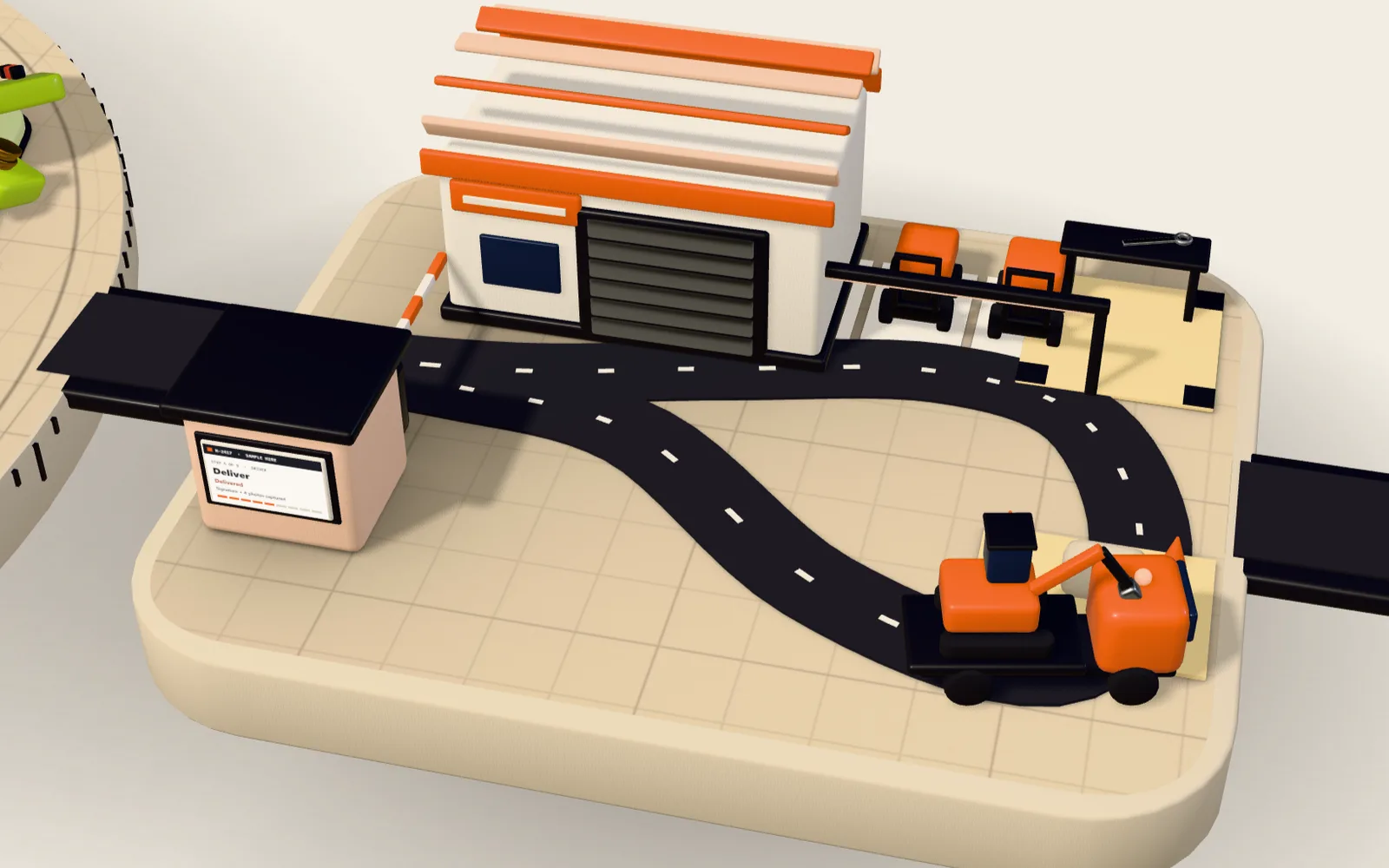
The problem
Rental is a lifecycle, not a list of bookings
Most rental software was built to handle bookings. Renttix was built to handle operations: equipment across several depots, deliveries to coordinate, invoicing at scale and accounts that have to stay in sync, all at once.
A single hire touches the hire desk, the warehouse, a driver, the workshop, accounts and the customer. In many businesses each of those people keeps their own version of the truth: a whiteboard, a spreadsheet, a clipboard in the cab, an accounting package. Every handover is a chance to re-type something and get it wrong.
So we built Renttix around a single hire record that carries each team’s work to the next, from the first phone call to the accounts. As we put it on renttix.com: “We build for the hire desk at 7am: the phone ringing, a van waiting and a customer asking whether the kit is free on Thursday.”
Inside the product
The screens our customers’ teams work in all day
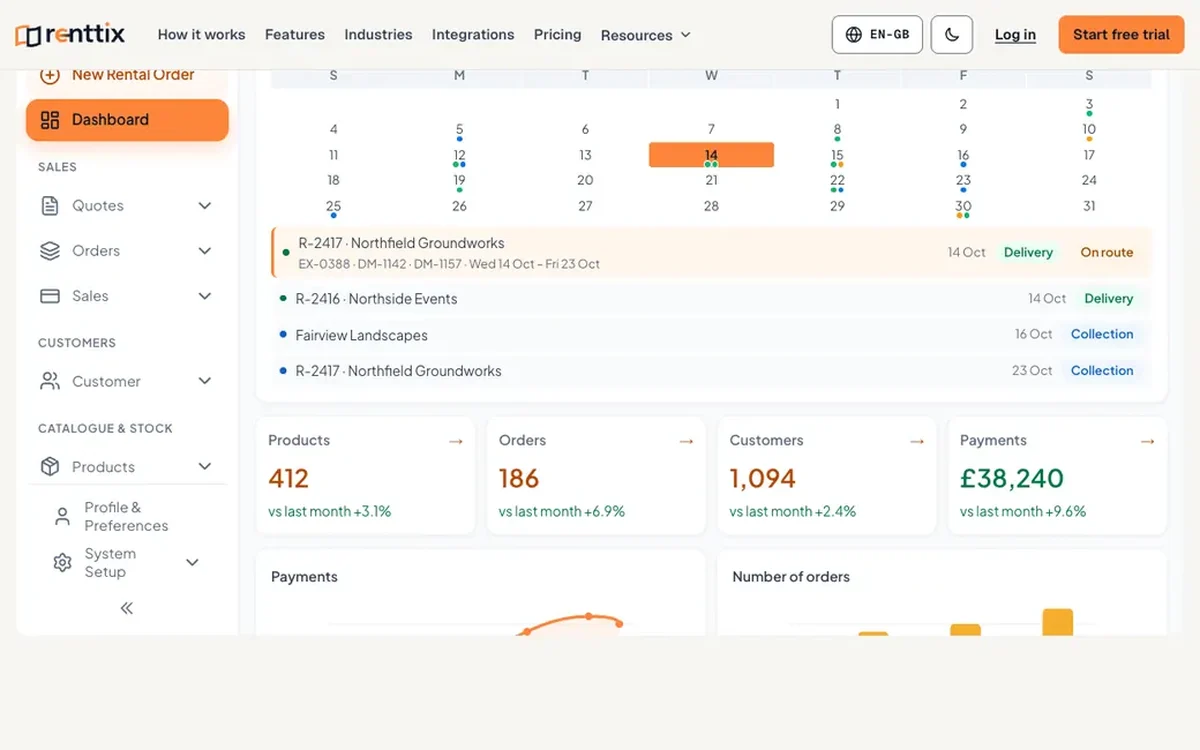
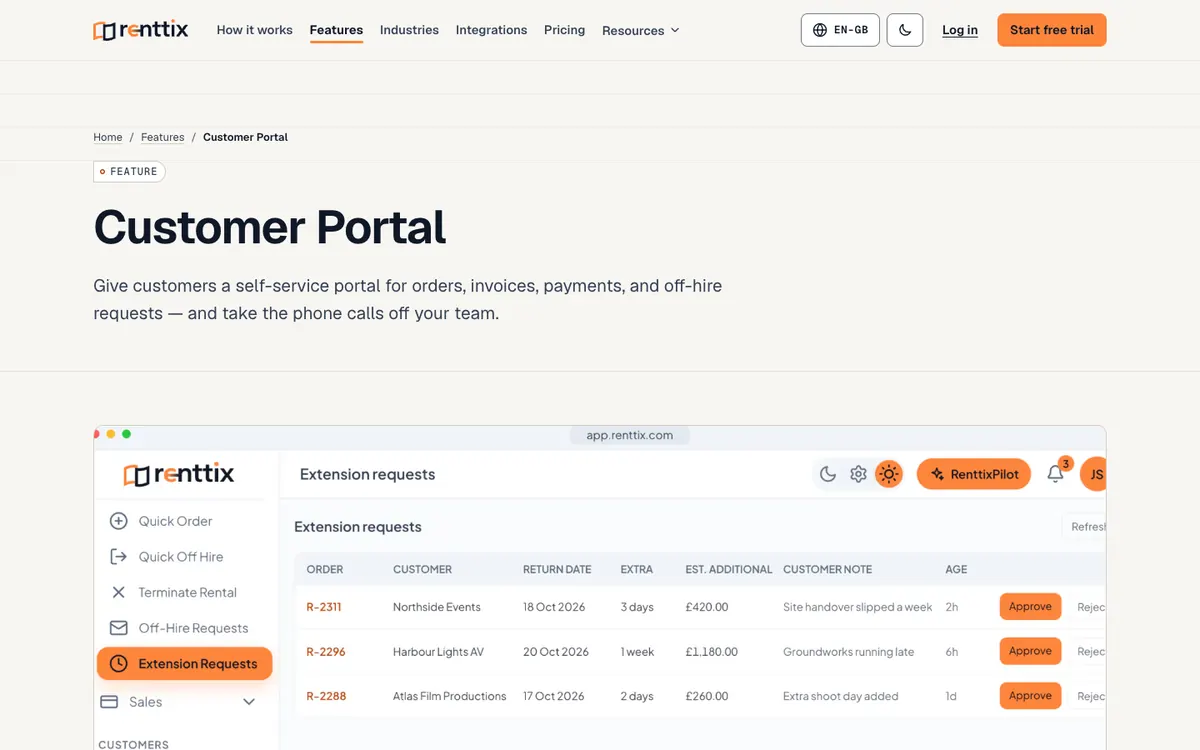
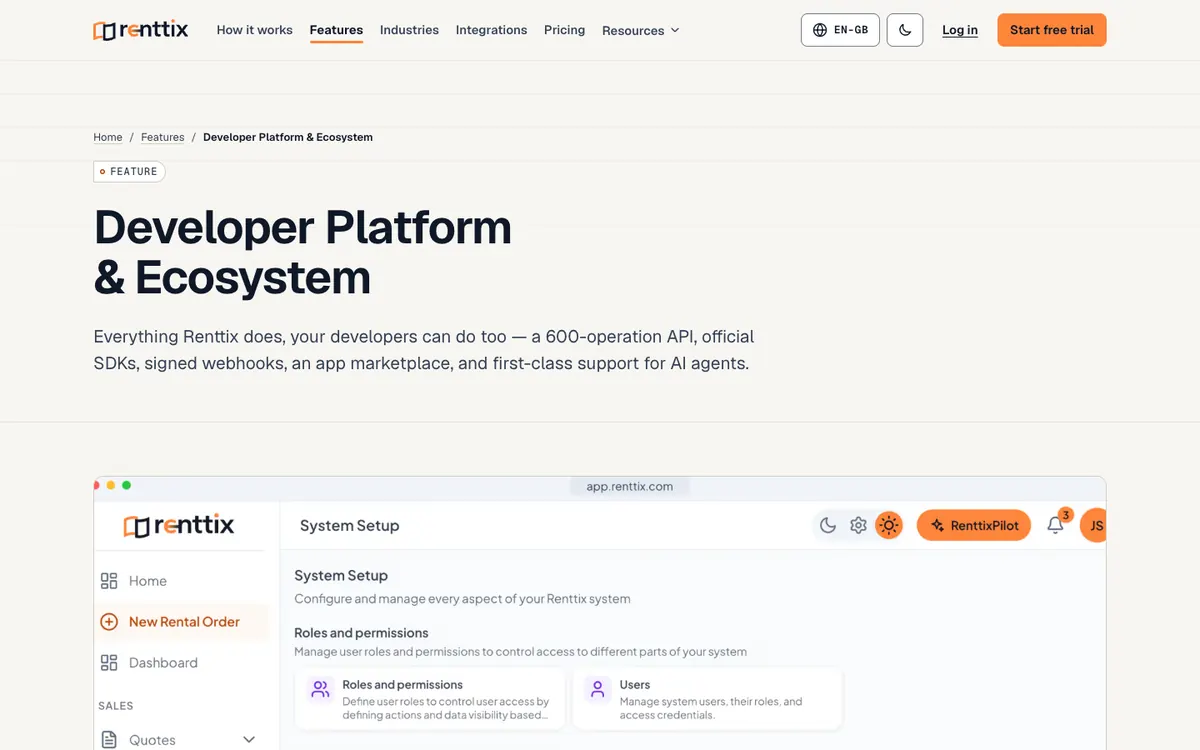
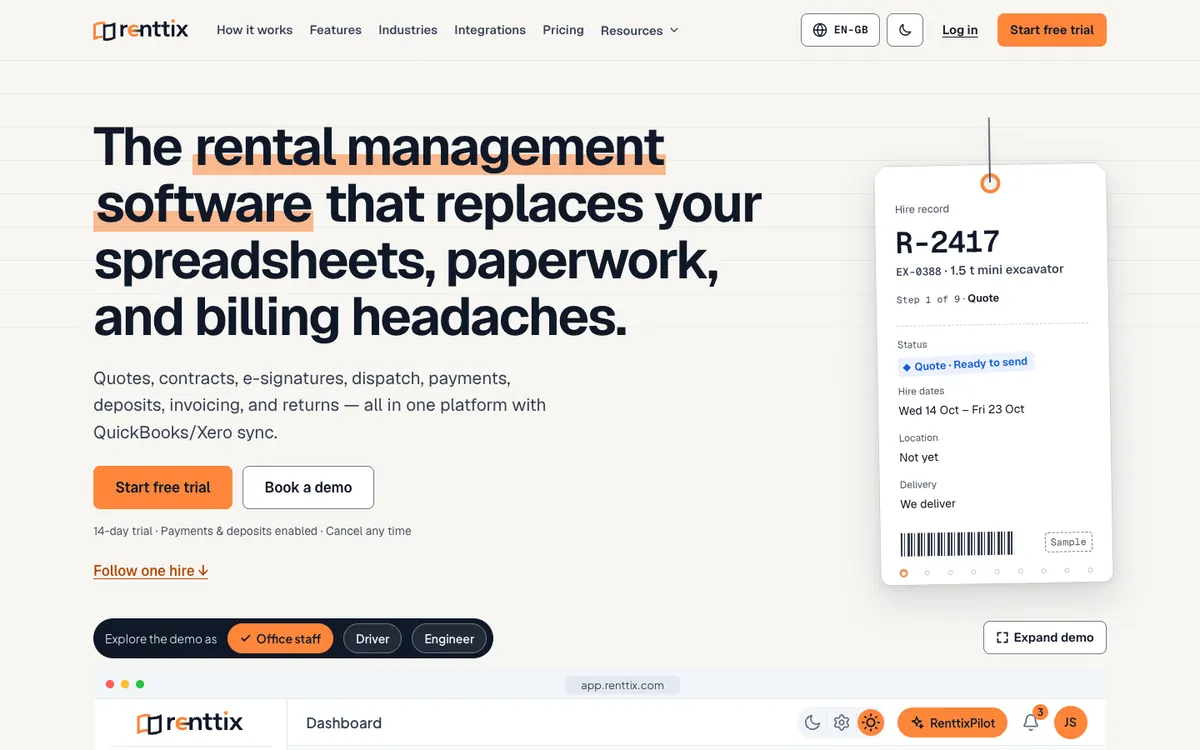
Screenshots of the live product and site. Customer names and figures are Renttix’s demo data.
How it is engineered
A product with real operations behind it
Renttix is not a website with a login. It is a multi-depot operational system with a public developer platform, and we run it in production. These are the engineering decisions behind it, each one published on renttix.com where you can check it.
People use
- Office web app
- Customer portal
- Online store & booking widget
- Renttix Field app (offline-first sync)
One shared core
- One hire record: quote → order → invoice
- Availability calendar
- Scan-driven warehouse
- Workshop & inspections
- Billing, deposits & credit notes
Built in, not bolted on
- SSO, passkeys & two-factor
- Server-side roles & permissions
- Redacting audit trail
Developer platform
- 600-operation REST API (OpenAPI 3.1)
- OAuth2 server + scoped keys
- Signed, replayable webhooks
- TypeScript & Python SDKs
- MCP server for AI agents
Connects to
- Stripe · PayPal · Square
- Xero · QuickBooks · Sage · Zoho
- Shopify · WooCommerce
- Twilio · WhatsApp · HubSpot
- D-01
One hire record behind every screen
The office app, the customer portal, the online store and the Field app all read and write the same record, from quote to invoice.
Why it matters to your build: Nothing is re-typed between teams, so the numbers in the warehouse, the office and the customer’s inbox always agree.
- D-02
Permissions enforced on the server, for every door
Roles are checked by the backend, so a user without financial permissions gets no financial data whether they use the interface, the API or the AI assistant. Sensitive changes are audited with before and after values, and sensitive fields are redacted.
Why it matters to your build: Security that lives in the core cannot be bypassed by a new screen, an integration or an AI feature added later.
- D-03
An API built on the conventions serious APIs share
600 operations with cursor pagination, idempotency keys for safe retries, a standard error envelope with request IDs and published rate limits. The SDKs are generated from an OpenAPI 3.1 contract, and a full OAuth2 server handles PKCE, client-credential and device sign-in.
Why it matters to your build: Partners and your own developers can integrate without guessing, and a retried request never charges a customer twice.
- D-04
Webhooks that do not lose events
Deliveries are HMAC-signed and retried on an escalating backoff. Deliveries that still fail go to a dead-letter queue instead of vanishing, and any event can be replayed. Ten versioned event types ship with published JSON Schemas.
Why it matters to your build: When another system depends on yours, a brief outage on either side becomes a delay, not lost data.
- D-05
Testing that cannot touch production
Every account has an isolated sandbox seeded with realistic data in one call. Test and live keys are separate, and the seeder refuses live keys.
Why it matters to your build: Experiments, demos and integration work happen against realistic data without any risk to real customers.
- D-06
AI with guard rails
RenttixPilot answers questions from live data with each user’s permissions enforced. Seven opt-in AI agents queue their work for approval, behind kill-switches.
Why it matters to your build: AI features are useful only if they respect the same rules as everything else, and a person stays in charge.
Sources, all public: developer platform (opens in a new tab), security and permissions (opens in a new tab) and the interactive developer demo (opens in a new tab) on renttix.com.
The workflow
Follow one hire, in nine steps
The same sequence Renttix walks through on its own site, from quote to invoice. Use the arrow keys or the buttons to move along the line.
Step 1 of 9 · Hire desk
Quote
The hire desk builds the quote once: customer, products, delivery, review. Delivery is decided here, so dispatch can plan against it.
Step 1: Quote
What it does
The parts of the product that carry the work
- RX-01
Customer portal
Customers see live orders and equipment on site, sign agreements, pay invoices and request off-hire without calling the office.
- RX-02
Warehouse & depot
Scan-driven pick lists, returns check-in with condition capture, damage flagging and mispick warnings before anything reaches the lorry.
- RX-03
Delivery & field app
Routes, automatic ETAs and proof of delivery captured in the Renttix Field app, with signatures and photos landing on the order.
- RX-04
Workshop
A return inspection gate that raises repair jobs, quarantines damaged assets and keeps each asset’s history attached.
- RX-05
Billing & accounting
Per-day, hourly, weekly or fixed-term rates, deposits, credit notes and refunds, with sync to QuickBooks, Xero, Sage and Zoho Books.
- RX-06
Security & access
Single sign-on, passkeys and two-factor authentication, with role-based permissions enforced server-side and an audit trail.
- RX-07
Developer platform
A documented REST API with scoped keys, signed webhooks with delivery logs, TypeScript and Python SDKs and a Zapier app.
- RX-08
Online store
A hosted storefront on the live catalogue, an embeddable booking widget, or Shopify and WooCommerce connections.
Product thinking
How the design follows the real process
- 01
One record, many hands
A quote converts to an order with nothing re-typed. The same record collects the signature, the payment, the scans, the photos and the invoice, so each team starts from what the last one did.
- 02
Built for the people who are not at a desk
Warehouse staff work the pick queue on a phone or tablet, and drivers capture proof of delivery in the Renttix Field app, so evidence lands on the order as it happens.
- 03
Customers help themselves
The customer portal lets hirers read quotes, sign agreements, pay, ask for extensions and request off-hire without ringing the office.
- 04
Damage does not slip through
Returned kit goes through an inspection gate. A damaged machine is quarantined with a workshop job instead of quietly going back out.
- 05
The invoice reflects what happened
Extensions, delivery and approved damage are already on the record, so the invoice is built from facts and synced to the accounting package.
Scale & integration
One depot or many. Your tools, connected.
Starter covers a single depot, Growth up to three and Scale as many as you need, with more users and integrations at each step.
Under the hood it is a multi-tenant platform with role-based permissions enforced on the server, single sign-on and passkeys, a documented REST API with signed webhooks, and SDKs for developers. That is the kind of structure we build into every SaaS product: the parts that let one platform serve many businesses safely.
Integrations
- Stripe
- PayPal
- Square
- Razorpay
- QuickBooks
- Xero
- Sage
- Zoho Books
- Shopify
- WooCommerce
- HubSpot
- Zapier
- Twilio
- what3words
- Calendar feed
Industries
- Equipment & machinery
- Vehicles & fleet
- Party & bouncy castles
- Portable accommodation
- Media, AV & production
- Furniture & office
- IT & tech equipment
- Tools & trade
- Event equipment
Why it matters to you
What running Renttix means for your project
Renttix is a Klixix company. We designed it, we built it and we run it. So the hard parts of a serious software product are things we have already done, not things we will learn on your budget.
- Data that has to stay correct across teams, sites and customers
- Permissions enforced on the server, sign-in that meets modern expectations, and an audit trail
- Payments, deposits and subscriptions, with accounting sync to Xero, QuickBooks, Sage and Zoho Books
- Warehouse and field screens that keep working when the signal drops
- An API, webhooks and SDKs other developers can build on
- Living with a product after launch, which is what most project teams never see
Every module in the Klixix machine shows up in it. The Platform for tenancy, roles and billing. The Engine Room for payments, accounting sync and the API. The Shopfront for the office screens, the portal and the field app.
Product facts on this page match what renttix.com publishes. We do not quote customer numbers or results here.
Talk to us about your platform Try Renttix (opens in a new tab)How we work
Last stop on the line
Building a product with real operations behind it?
That is exactly what we build, because we run one. Tell us what yours needs to do and we will tell you, honestly, how we would approach it.